

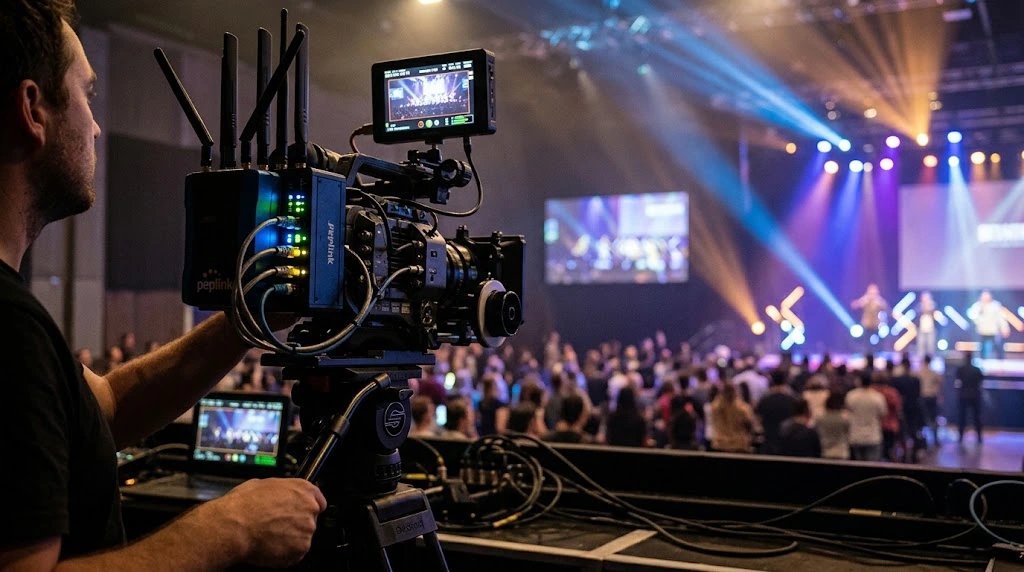
Broadcasting live video in 1080p60 or 4K mandates an uncompromising, sustained upload throughput between 8 and 25 Mbps with zero jitter. Off-the-shelf connectivity solutions fail under load, triggering catastrophic stream termination once packet loss hits 2%.
Reading time: 12 min | Category: Event Streaming & Broadcast Engineering | Updated: September 2026
Key Technical Takeaways
- Mission-Critical Uplink Throughput: Professional 1080p60 and 4K broadcast workflows require an uninterrupted, symmetric upload rate of 8 to 25 Mbps. In live contribution networks, packet loss exceeding 2% causes irrecoverable pipeline collapse.
- Packet-Level Peplink SpeedFusion Bonding: Unlike conventional layer-4 load balancers, SpeedFusion aggregates multiple multi-carrier 5G/4G modems (e.g., Orange, SFR, Bouygues Telecom) alongside low-Earth-orbit (LEO) Starlink terminals packet by packet into a unified, ultra-resilient SD-WAN tunnel.
- Zero-Downtime Architecture: SpeedFusion WAN Smoothing and sub-second Hot Failover duplicate critical broadcast packets simultaneously across all active WAN interfaces, completely eliminating dropped frames and jitter during carrier-side link degradation or cell handovers.
- Turnkey Production Cases: Welink deploys enterprise-grade flight cases integrated with Peplink MAX BR1 Pro 5G and multi-modem hardware, fully pre-configured and shipped within 24 hours across France with proactive centralized cloud monitoring.
1. The Live Event Broadcast Failure Mode: When the Uplink Drops in Front of Thousands
Live event broadcasting tolerates zero packet degradation. Standard contribution and distribution protocols—such as RTMP, SRT, and NDI—rely on an uninterrupted, jitter-free transmission pipeline. A micro-outage or severe packet loss event lasting just two seconds does not merely cause an imperceptible visual artifact; it drops the transport session entirely. The remote CDN drops the ingest point, instantly terminating a sponsored multi-camera broadcast or concert stream in front of thousands of concurrent viewers.
Consumer and commercial-grade asymmetric connections present a deceptive metric profile. A speed test indicating 200 Mbps downstream offers zero technical assurance for production teams. In professional live video contribution, sustained upstream throughput is the sole governing operational metric. Production switchers and hardware encoders require steady, deterministic upload capacity, typically between 8 and 25 Mbps, scaled across single or multi-stream workflows. Massive download bandwidth does not mitigate uplink constraints.
During major public gatherings, massive radio frequency (RF) cell congestion throttles regional base stations. Thousands of active devices upload high-resolution media simultaneously, saturating the uplink subcarriers of local eNodeB/gNodeB towers. This uncontrolled contention chokes the available uplink budget for production crews—regardless of whether consumer SIM cards carry "unlimited" data plans. Resolving this constraint requires multi-carrier bonded field routers, as explored in our enterprise multi-carrier 4G/5G router benchmark.
Deploying smartphone tethering for mission-critical video transmission constitutes an unacceptable operational risk. Designed strictly for intermittent, single-client web browsing, consumer tethering lacks carrier aggregation control, automated failover logic, dynamic MTU optimization, and enterprise Quality of Service (QoS) queues necessary to preserve video integrity. This systemic instability is directly resolved by bonding Starlink with enterprise 5G routers via SD-WAN. Tethering exhibits volatile throughput, uncontrollable bufferbloat, and zero jitter mitigation.
[WARNING] The 2% Packet Loss Threshold Unlike standard HTTP web browsing, which relies on asynchronous TCP retransmissions, live contribution protocols (RTMP/SRT) cannot survive sustained transport-layer degradation. Once unrecovered packet loss exceeds 2%, hardware encoders exhaust their internal buffers, the CDN ingest socket collapses, and the production drops offline with zero seamless recovery mechanism.
2. Technical Benchmark: 4G Dongle vs. Consumer Hotspot vs. Welink SpeedFusion Bonded System
Uninterrupted broadcast contribution requires absolute payload integrity. Consumer-grade connectivity hardware—such as standard 4G USB dongles and consumer battery-powered hotspots—inherently fails under demanding broadcast environments. Their single-modem architecture or rudimentary session-based load balancing offers no defense against micro-interruptions, uplink packet loss, or carrier jitter spikes.
A single-SIM dongle or hotspot introduces a fatal single point of failure (SPOF). Session-based load balancing merely distributes discrete TCP/UDP connections across interfaces. Because an active RTMP or SRT stream constitutes a single sustained transport session, it cannot be split across links by conventional multi-WAN routers. If that active link degrades, the entire session fails, triggering a catastrophic freeze. Furthermore, consumer mobile hotspots frequently exhibit jitter exceeding 150 ms, breaking audio-video synchronization and rendering contribution feeds unusable for broadcast-grade production.
In contrast, Peplink SpeedFusion operates true packet-level bonding. The underlying engine fragments outbound IP packets, assigns dynamic sequencing metadata, and dispatches them across concurrent 4G/5G and satellite links before reassembling them transparently at the SpeedFusion Cloud or private data center endpoint. The WAN Smoothing algorithm replicates critical video packets across diverse WAN links simultaneously. If one mobile carrier suffers an instantaneous drop or signal degradation, identical packets arrive without interruption via the secondary or tertiary link. This architecture stabilizes end-to-end jitter below 15 ms and integrates natively with industry-standard production hardware (Blackmagic ATEM, vMix, NewTek TriCaster) through hardened Gigabit Ethernet interfaces. For a detailed architectural breakdown of hybrid bonding topologies, read our technical brief on why Starlink should be bonded with 5G SD-WAN.
[WARNING] Financial and Reputational Risk Analysis A 30-second stream outage during a prime live broadcast can trigger a 20% immediate drop in live concurrent viewers and inflict long-term brand damage. For sponsored events generating €10,000/minute in commercial inventory, a 5-minute transmission failure results in an immediate €50,000 direct revenue loss, excluding contractual penalties and client attrition.
Technical Comparison: Broadcast Connectivity Architectures for Live Video Streaming
| Technical Specification | Smartphone Tethering / Hotspot | Consumer Single-SIM 4G Router | Welink Peplink SpeedFusion 5G Case |
|---|---|---|---|
| Guaranteed Uplink Throughput | Highly volatile (2 to 8 Mbps erratic) | Bottlenecked (5 to 15 Mbps shared) | Dedicated up to 80–150 Mbps aggregated |
| Aggregation Layer | None (Single cellular interface) | None (Single-operator locked) | True Layer-2/Layer-3 packet-level bonding |
| In-Flight Failover Latency | Instant stream crash on interface drop | 30s to 2min blackout during reconnect | 0 ms (WAN Smoothing packet replication) |
| Jitter Performance | Erratic swings (>150 ms under load) | High variance based on cell load | Normalized via SpeedFusion Cloud (<15 ms) |
| Production Interfacing | 802.11 Wi-Fi only (high RF interference) | 1–2 standard unmanaged RJ45 ports | Ruggedized GbE ports for ATEM, vMix, TriCaster |
| Operational Flexibility | Long-term consumer plan or personal SIM | 12/24-month fixed contract | Turnkey short-term dispatch (per day or weekend) |
3. SpeedFusion Engineering: Packet-Level Replication and Multi-Carrier Aggregation
Peplink SpeedFusion technology defines the modern benchmark for high-availability temporary networking. By dynamically aggregating heterogeneous WAN circuits into a single virtual tunnel, it optimizes both raw payload capacity and end-to-end transport determinism.
The SpeedFusion engine deconstructs transport streams into individual IP packets, applying real-time forward error correction (FEC) and packet ordering. It distributes this traffic intelligently across concurrent physical interfaces: Orange, Bouygues Telecom, SFR, and Starlink Business LEO satellite terminals. This multi-operator matrix eliminates local carrier-specific cell exhaustion, delivering the symmetrical, sustained 25 Mbps upload mandatory for uncompressed or low-compression 4K contribution workflows—an operational advantage detailed throughout our enterprise deployment benchmarks.
Besoin d'une connectivité 4G/5G haute performance sans coupure ?
Chantiers BTP, événements, pop-up stores ou backup entreprise : Welink déploie vos valises 4G/5G multi-opérateurs prêtes à l'emploi partout en France sous 24h.