

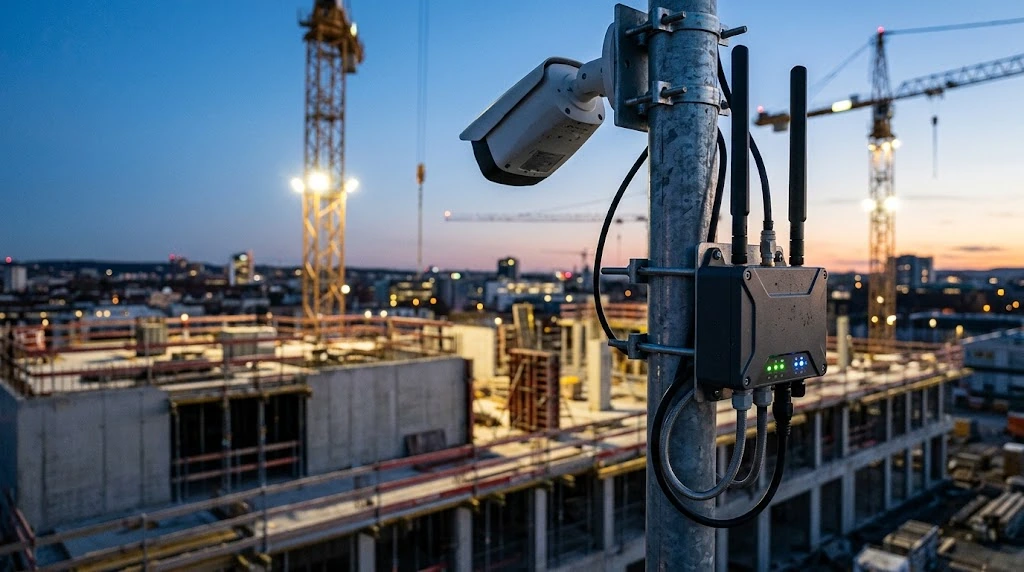
With over €1.2 billion in annual losses attributed to construction site theft across Europe, remote IP video surveillance demands a sustained, reliable uplink throughput of 4 to 12 Mbps. Consumer-grade connectivity fails under load, exposing sites to unmitigated risk and voiding insurance claims.
Reading Time: 12 min | Category: Site Security & IoT Video Surveillance | Updated: September 2026
Key Technical Takeaways
- €1.2B Annual Theft Exposure: Jobsite theft represents an acute financial and operational risk. 24/7 video surveillance with verified alarm confirmation (video verification) is a mandatory condition under most enterprise insurance policies.
- Sustained Upload Constraints (4-12 Mbps): HD/4K IP cameras require continuous, unthrottled upstream bandwidth. Off-the-shelf consumer routers drop packets under peak loads, causing critical video stream freezes.
- Multi-Carrier Resilience and Public IP Provisioning: An industrial-grade 4G/5G router featuring sub-300ms failover and a statically routed public IP is mission-critical for maintaining uninterrupted RTSP/ONVIF streams to Alarm Receiving Centers (ARCs).
- PoE Integration and Power Redundancy: Edge cellular routers with integrated 802.3af/at PoE switches and battery/UPS backup guarantee direct camera power delivery and automated alerting during grid power cuts or deliberate sabotage.
1. Jobsite Theft Economics: Why Autonomous Video Surveillance Is Non-Negotiable
Commercial construction sites face massive, systemic losses exceeding €1.2 billion annually due to organized on-site theft. Target profiles are predictable: bulk copper spools, diesel reserves, heavy earthmoving equipment, and precision power tools. The fallout extends far beyond replacement hardware: it causes total site shutdowns, missing project delivery milestones, and heavy contractual late-delivery penalties.
Underwriters and commercial insurance carriers have updated their underwriting criteria in response. Contractors' All Risks (CAR) policies routinely require active, monitored surveillance systems backed by 24/7 central-station video verification before authorizing claims. A communication drop or unrecorded breach leads directly to a forfeiture of coverage, shifting catastrophic replacement and operational costs entirely onto the general contractor.
Field deployments frequently rely on standalone, solar-powered 4G cameras—a stopgap that introduces severe architectural vulnerabilities. These distributed edge units suffer from carrier-band fluctuations, excessive trigger latencies that miss fast-moving targets, and unmonitored on-board SD card storage. If a camera is sabotaged or stolen, the evidence disappears with the hardware.
Securing a modern construction perimeter requires a centralized topology built on a high-throughput Network Video Recorder (NVR) and an industrial-grade 4G/5G router. This configuration delivers the reliable backhaul required for temporary internet connections across demanding jobsites. It is the only architecture capable of sustaining continuous RTSP feeds, maintaining real-time video verification, and preserving full policy compliance.
[WARNING] Insurance Invalidation via Connection Drops If an intrusion occurs while a consumer 4G router is desynchronized or locked into an unrouted cell tower, the Alarm Receiving Center (ARC) cannot verify the alarm or dispatch law enforcement. Insurers will legally invoke gross negligence clauses and deny indemnification due to the absence of active, verified surveillance.
2. Technical Benchmark: Consumer 4G Modems vs. Standalone Solar Cameras vs. Welink Industrial Architecture
Nomadic jobsite CCTV demands deterministic uplink performance and continuous availability. Engineering teams typically evaluate three deployment models: retail consumer 4G modems, standalone solar-powered 4G cameras, and Welink's centralized industrial architecture. A granular breakdown of network capability and operational overhead highlights why entry-level alternatives fail in commercial environments.
Residential 4G routers are architected exclusively for asymmetric consumer traffic (high download, negligible upload). When subjected to continuous video streams from more than two IP cameras, their radio basebands saturate, buffer bloat escalates, and video streams collapse. Conversely, standalone solar units introduce operational friction: managing multiple cellular SIMs, contending with upstream throttles capped at 1-2 Mbps per unit, and facing complete battery depletion during overcast winter periods.
Welink's enterprise deployment bypasses these bottlenecks through an industrial multi-SIM 4G/5G cellular platform. By orchestrating SIM failover across multiple Tier-1 carriers, the system guarantees an upstream capacity of up to 80 Mbps. This headroom effortlessly powers 8 to 16 full HD cameras concurrently without packet loss. Sub-300ms multi-SIM failover eliminates dropouts, immediately rerouting transport if a primary mobile network operator drops RF carriers.
On the hardware layer, the embedded 802.3af/at Power over Ethernet (PoE) switch consolidates both data and power delivery across a single ruggedized Cat6 RJ45 drop per camera. By provisioning public, statically routed IPv4 addresses alongside persistent IPsec/WireGuard VPN endpoints, Welink completely removes the carrier-side NAT (CGNAT) barriers that plague consumer connectivity. Monitored 24/7 by Welink-tech's Carrier NOC (established 2010), this platform enforces enterprise SLA metrics on temporary sites.
[TIP] TCO Comparison: Centralized Hub vs. Distributed Units Consolidating video streams into a single centralized industrial cellular gateway delivers an all-in infrastructure cost 50% lower than procuring, mounting, and managing five individual solar 4G units. Concurrently, operational reliability increases by a factor of 10x. Automated carrier-level health checks, proactive NOC telemetry, and expedited next-business-day hardware swaps eliminate the hidden operational overhead of fragmented deployments.
Comprehensive Architectural Comparison for Construction CCTV Connectivity
| Technical & Operational Metric | Consumer Retail 4G Modem | Standalone Solar 4G Cameras | Welink Industrial 4G/5G CCTV Pack |
|---|---|---|---|
| Uplink Bandwidth (Upload) | Unstable; throttles during peak cell hours | Hard-capped at 1-2 Mbps per camera | Prioritized, guaranteed uplink up to 80 Mbps |
| Supported IP Camera Density | 1 to 2 units max (frequent buffer drops) | 1 camera per SIM card / solar pole | Up to 8 to 16 continuous HD streams |
| Network Link Redundancy | None (Single operator, residential profile) | None (Single cellular path per unit) | Automated Multi-Operator Failover in <300 ms |
| Power Delivery & Topology | Separate 230V AC local feeds required | Integrated solar panels (weather-dependent) | Integrated PoE/PoE+ Switch (single RJ45 drop) |
| Remote ARC / NVR Access | Blocked by Carrier-Grade NAT (CGNAT) | Latent, proprietary vendor cloud apps | Static Public IPv4 & Native IPsec/WireGuard |
| Deployment Turnaround | 3 to 5 business days (standard consumer setup) | Complex assembly across individual poles | Pre-configured, zero-touch provisioning in 24 hours |
| Contract Structure | 12-24 month rigid consumer contracts | Multiple, uncoordinated data subscriptions | Single unified contract, dynamic duration billing |
3. The Uplink and Public IP Mandate: Zero-Latency RTSP Feeds and Central Monitoring
Enterprise CCTV deployments rely heavily on sustained upstream network paths. Consumer cellular tiers prioritize downstream traffic, choking outbound connections. A standard 4K surveillance feed utilizing H.264/H.265 compression at 25 fps demands a reliable, jitter-free upstream pipe of 15 to 25 Mbps per primary encoder. Standard mobile hotspots and consumer SIMs cannot sustain this throughput without buffer-induced latency or severe packet drops. For a wider evaluation of temporary field deployments, our guide on temporary connectivity for events and construction sites breaks down these network realities.
Carrier-Grade NAT (CGNAT), standard across standard mobile telecom profiles, presents a critical roadblock. Mobile operators assign private IP addresses behind an operator-side NAT firewall. This architecture blocks all inbound traffic. As a result, remote security teams and ARC monitoring platforms cannot establish direct, low-latency RTSP (Real-Time Streaming Protocol) or ONVIF connections to the site NVR.
Overcoming CGNAT requires either a routable, static public IPv4 address assigned directly to the router's cellular interface or an enterprise SD-WAN/VPN tunnel overlay (such as Peplink SpeedFusion or route-based IPsec). This configuration allows ARCs to ingest telemetry directly, trigger zero-delay PTZ commands, and stream uninterrupted, multi-camera feeds at native resolutions without dependency on unreliable third-party peer-to-peer cloud relays.
Besoin d'une connectivité 4G/5G haute performance sans coupure ?
Chantiers BTP, événements, pop-up stores ou backup entreprise : Welink déploie vos valises 4G/5G multi-opérateurs prêtes à l'emploi partout en France sous 24h.