

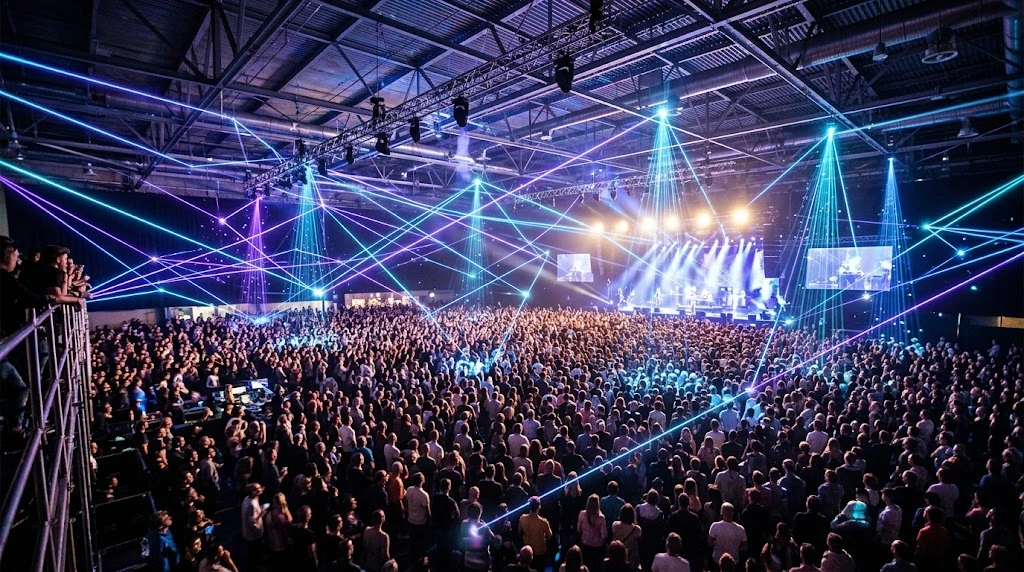
Facing 5,000 attendees and 1.8 connected devices per capita, RF spectrum exhaustion jeopardizes €12,000/hour in merchant revenue. Discover the Welink network architecture designed to guarantee an inviolable QoS for payment processing.
Reading Time: 12 min | Category: High-Density Event Wi-Fi | Updated: September 2026
Key Takeaways
- Inevitable Radio Congestion: An average of 1.8 client devices per attendee rapidly exhausts the 2.4/5 GHz spectrum, risking €12,000/hour in financial loss due to payment terminal (POS) blackouts.
- Air-Gapped Payment QoS: Welink's architecture segments traffic across three isolated VLANs, guaranteeing 20 Mbps of dedicated throughput to POS and cashless systems even under peak RF load.
- Multi-Carrier 5G SD-WAN Bonding: Aggregating 4 industrial 5G modems via packet-level bonding delivers up to 1.2 Gbps aggregate throughput with sub-second hitless failover.
- Optimized Physical Layer Deployment: IP67 Wi-Fi 6 access points mounted on 5-meter pneumatic masts mitigate human body attenuation, covering up to 10,000 m² within a 24-hour deployment window.
1. The Reality of Radio Saturation: Why Legacy Cellular Fails Under Peak Densities
Mass gatherings systematically overwhelm standard public cellular infrastructures. An event hosting 3,000 to 5,000 attendees generates active network association demand for 1.8 client devices per person, representing up to 9,000 active wireless endpoints. In non-metropolitan or rural festival sites, this concentration forces thousands of user devices to negotiate uplink resources with the same localized macro cell tower. The resulting base transceiver station (BTS) resource block exhaustion collapses usable bandwidth—a challenge thoroughly examined in our temporary connectivity guide for construction sites and events.
This bottlenecks operations into a catastrophic scenario: Electronic Point of Sale (POS) freeze. Deprived of reliable transport, credit card readers and mobile payment terminals reject transactions. Queues cascade across vendor locations and access gates, creating friction and operational paralysis. Every hour of POS downtime represents an estimated direct financial loss of €12,000, compounded by brand damage and operational security vulnerabilities.
Overcoming this localized spectral collapse mandates enterprise-grade Wi-Fi 6 (802.11ax). Standard Wi-Fi implementations fall victim to 2.4 GHz noise floors and adjacent-channel interference across the 5 GHz band. In contrast, Wi-Fi 6 leverages Orthogonal Frequency-Division Multiple Access (OFDMA) to divide wireless channels into discrete Resource Units (RUs). This enables concurrent transmissions from multiple endpoints inside a single transmission opportunity (TXOP). By quadrupling channel spectral efficiency in high-density environments, Wi-Fi 6 preserves low-latency bidirectional communication under severe contention.
Beyond RF performance, regulatory requirements are uncompromising. Deploying public-facing networks requires compliance with mandatory telecom directives (including ARCEP stipulations and data retention decrees). Organizers are legally obligated to archive non-repudiated connection logs (NAT translations, public IP assignments, MAC addresses, timestamps) for a minimum rolling 12-month period. Overlooking these requirements exposes event organizers to criminal liability and commercial fines.
[WARNING] The True Cost of Payment Infrastructure Failure At a 3,000-attendee festival, an end-to-end network drop disabling ticketing scanners and cashless POS systems for just 45 minutes results in an unrecoverable average revenue deficit of €15,000, accompanied by critical bottlenecking at egress control points.
2. Event Connectivity Benchmark: Consumer Gateways vs. Welink Enterprise SD-WAN
Production deployments—ranging from multiday music festivals to enterprise trade shows—demand uncompromised uptime and low jitter. The underlying physical and transport layers dictate the success of core services: ticketing access control, banking POS/cashless systems, real-time inventory management, and attendee Wi-Fi. A technical audit of deployment architectures highlights massive disparities in resilience and total cost of ownership (TCO).
Deploying consumer-grade single-SIM 4G/5G gateways is an operational failure mode. Engineered for domestic traffic profiles, these consumer chipsets experience hardware buffer bloat and connection state exhaustion beyond 15 to 30 concurrent associations. Latency increases non-linearly, packet drops trigger TCP back-offs, and critical payments time out. The absence of dynamic Class of Service (CoS) or QoS engines renders point-of-sale traffic unpredictable.
Conversely, a temporary dedicated fiber line (FTTO) offers multi-gigabit symmetric throughput but suffers from prohibitive operational lead times. Installation requires 6 to 12 weeks of lead time, civil works permits, and capital expenditure ranging from €8,000 to €25,000 for a short-term deployment window. For an in-depth breakdown of field-ready alternatives, consult our temporary industrial router comparison. This legacy approach fails the agility requirements of modern event infrastructure.
Welink Tech's hybrid multi-SIM infrastructure breaks this paradigm. Powered by industrial hardware (Teltonika and Peplink SD-WAN appliances) and integrated by Welink-tech—a critical network operator operating since 2010—our solutions leverage packet-level bonding across multiple Tier-1 carriers (Orange, SFR, Bouygues, Free), complemented when necessary by low-latency Starlink Business backhaul. Pre-engineered kits deploy within 24 hours across continental Europe on zero-commitment terms, offering up to 4x lower TCO than traditional temporary fiber drops.
[WARNING] The Financial Cost of Inadequate Bandwidth Planning Unstable network backhaul results in an average 15% top-line loss across cashless transaction volumes. On an event generating €500,000 in gross merchant volume, this represents €75,000 in lost revenue. Temporary connectivity is not a cost center; it is the financial backbone of your event.
Technical Comparison: Temporary Event Internet Architectures (1,000 to 5,000 Attendees)
| Engineering Criteria | Consumer Single-Carrier 4G/5G Gateway | Dedicated Temporary Fiber (FTTO) | Welink High-Density Event Infrastructure |
|---|---|---|---|
| Concurrent Associations | 15–30 endpoints (AP CPU & RF collapse) | Unlimited (dependent on deployed APs) | 500 to 5,000 active, load-balanced sessions |
| POS / Cashless SLA | None (drops during cell tower saturation) | High throughput, single physical point of failure | Air-gapped ringfencing (Dedicated VLAN + QoS Priority 1) |
| Lead Time | Immediate (unreliable plug-and-play) | 6 to 12 weeks (heavy civil engineering) | Shipped in 24h, fully configured and plug-and-play |
| Outdoor RF Coverage | Limited (<20 meters, internal antennas) | Cable run dependent | Up to 10,000 m² via mast-mounted IP67 Wi-Fi 6 APs |
| Approximate Budget | €50 to €100 (high risk of failure) | €8,000 to €25,000 (rigid CapEx/OpEx) | From €490 / event, no long-term commitment |
| Network Operations (NOC) | Consumer call center support | Standard business hours | 24/7 dedicated engineering NOC + on-site field tech option |
- Multi-SIM bonded cellular uplinks secure sustained bidirectional throughput, dynamic packet steering, and sub-second link failover during event traffic surges.
- Granular 802.1Q VLAN segmentation and Layer 3 DSCP traffic tagging isolate transaction streams from public traffic, guaranteeing low latency for financial transactions.
- Zero-commitment rental options and rapid 24-hour turnaround provide enterprise-grade reliability without long-term carrier lock-in.
3. Mission-Critical Engineering: VLAN Segmentation and Dynamic QoS
Welink’s high-density network deployments enforce strict 802.1Q VLAN separation paired with Layer 3/Layer 4 traffic prioritization engines. Our baseline engineering policy is absolute: never bridge public user traffic and commercial transaction streams onto the same subnet or broadcast domain.
To ensure total operational resilience, production environments are segmented into three dedicated virtual networks:
- VLAN 10 - Payment & Cashless Core: Hard-coded DSCP 46 (Expedited Forwarding) traffic policies. Outbound bandwidth is permanently ringfenced at a minimum committed information rate (CIR) of 20 Mbps with high-priority queuing, protecting payment traffic from congestion.
- VLAN 20 - Production & Ticketing Gateways: Dedicated access for access-control validation, venue management, and live artist production. Configured with dynamic bandwidth allocation and isolated DHCP scopes to prevent IP address pool depletion.
- VLAN 30 - Public & Guest Access: Enforces hard downstream/upstream per-client bandwidth limits (e.g., 2 Mbps / 512 Kbps), isolates wireless clients (peer-to-peer blocking), and filters bulk bandwidth traffic (video streaming, cloud backups, P2P). Integrates fully with compliant captive portals logging sessions according to statutory data retention frameworks.
Besoin d'une connectivité 4G/5G haute performance sans coupure ?
Chantiers BTP, événements, pop-up stores ou backup entreprise : Welink déploie vos valises 4G/5G multi-opérateurs prêtes à l'emploi partout en France sous 24h.