
Modern audiovisual productions generate 500 GB to 3 TB of 4K/8K raw dailies per day. Maintaining a sustained 50–100 Mbps uplink is critical to preventing post-production bottlenecks that cost productions up to €8,000 per hour.
Reading Time: 12 min | Category: Film Production & Broadcast Engineering | Updated: September 2026
Key Technical Takeaways
- Mission-Critical Data Volumes: A single production day yields between 500 GB and 3 TB of 4K/8K camera footage, requiring a rock-solid 50–100 Mbps sustained uplink for native Camera-to-Cloud (C2C) ingest.
- The Financial Cost of Latency: Operating without dedicated ultra-high-speed uplink on set delays editorial post-production turnaround by 24 to 48 hours, idling production teams valued between €2,000 and €8,000/hour excl. VAT.
- Multi-Operator 5G Channel Bonding: Welink Tech bonding appliances pool physical links across Tier-1 carriers (Orange, SFR, Bouygues Telecom) via packet-level SD-WAN bonding to deliver aggregate uplinks of 80 to 250 Mbps with zero fair-use throttling.
- Autonomous Field Deployments: Welink Tech broadcast flypacks—engineered in IP67 ruggedized cases with integrated 8–10 hour LiFePO4 power architectures—deliver operational 100+ Mbps connectivity within 45 seconds of deployment in off-grid locations.
1. Post-Production Bottlenecks: The Hidden Cost of Trapped Dailies on Set
Modern digital cinematography relies on high-resolution sensor architectures. 6K and 8K imaging systems, paired with uncompressed 12-bit or 16-bit RAW formats (Apple ProRes RAW, ARRI RAW, REDCODE), routinely output 500 GB to 3 TB of dailies per day. This data density creates operational bottlenecks for location production teams, directly stalling downstream editorial and VFX workflows.
Legacy production workflows still depend on physical storage media (NVMe drives, RAID shuttles) physically transported via runner to remote post-production facilities. This operational approach introduces critical failure points: physical drive loss, file system corruption, and non-compressible transport latency. Physical media dispatch introduces a 24- to 48-hour delay before editorial teams can ingest media, locking editorial workflows into rigid, serialized schedules.
Simultaneously, major streaming platforms, networks, and production agencies require near real-time dailies verification and cloud review. Without a high-throughput, enterprise-grade uplink capable of sustaining 50 to 100 Mbps symmetric throughput, securely transferring lightweight proxy files (H.264/H.265) is impossible—a problem directly solved by our bonded 5G multi-carrier routers for live event streaming and broadcast. Remote or off-grid locations lacking robust cellular uplink force delayed creative and technical sign-offs, compounding production overhead.
The resulting fiscal exposure is significant. Complete principal photography crew overhead averages between €2,000 and €8,000/hour excl. VAT. Delaying shot approvals, framing confirmations, or focus verification until after wrapping a location invites catastrophic reshoot costs. When dailies validation cannot occur in real time, operational margins erode rapidly.
[WARNING] The Financial Cost of Ingestion Delays For feature films and high-tier commercial productions, total crew overhead runs between €2,000 and €8,000/hour excl. VAT. Deferring proxy uploads until crew return to base accommodation pushes technical verification to the following morning, completely eliminating the opportunity for immediate set adjustments or critical pickup shots.
2. On-Set Connectivity Benchmark: Consumer Dongles vs. Hotel/Location Wi-Fi vs. Welink Tech Broadcast Flypacks
High-end audiovisual production requires uninterrupted uplink performance. Fast file transfer, live remote monitoring, and collaborative post-production demand enterprise-tier throughput and sub-second failover. Consumer-grade or improvised workarounds routinely result in connection drops, data throttling, and severe production delays.
A single 4G/5G consumer dongle or mobile hotspot delivers actual field uplink rates between 3 and 15 Mbps, compounded by aggressive signal instability. This bandwidth profile fails to support sustained Camera-to-Cloud (Frame.io, Teradek C2C) workloads, leading to transmission timeouts and sync failures. Furthermore, consumer data plans enforce severe traffic shaping or bandwidth caps after 50 to 100 GB of consumption, halting operations mid-shoot.
Location and hotel Wi-Fi networks suffer from architectural limitations. Upload bandwidth is heavily contention-bound, shared with hundreds of unmanaged third-party devices, and typically caps between 5 and 20 Mbps. Such infrastructures lack packet prioritization (QoS), expose media to basic network security vulnerabilities, and collapse when a 15+ person crew connects simultaneously, resulting in unusable latency spikes.
The Welink Tech Broadcast Flypack, engineered on the backbone of Welink-tech (a French B2B telecommunications operator established in 2010), bonds multiple Tier-1 cellular links (Orange, SFR, Bouygues Telecom) at the packet level. It delivers a sustained uplink between 80 and 250 Mbps, pre-configured and certified for end-to-end Camera-to-Cloud workflows. Housed within a ruggedized, water-resistant chassis, it integrates internal LiFePO4 battery infrastructure yielding 8 to 10 hours of autonomous field operation. It easily accommodates up to 150 concurrent client devices with dynamic QoS prioritization—ideal for mission-critical video streaming and remote broadcast control.
Production cost mathematics are definitive. A 4-hour connectivity outage on an active film set incurs secondary costs between €10,000 and €50,000 in crew idling, specialized equipment rentals, and schedule overruns. Welink Tech’s 24/7 technical on-call engineering support, managed directly by Welink-tech NOC engineers, ensures rapid fault isolation—a sharp contrast to consumer ISP customer support tiers. Available under fully flexible, day-rate rentals without rigid 24- to 36-month contractual lock-ins. For an architectural deep dive into bonding technologies, explore our analysis of Peplink SpeedFusion SD-WAN 4G/5G/Starlink bonding.
[WARNING] The Real Cost of Improvised Set Connectivity A 30-minute network outage on an active production translates to an average direct loss of €2,500 in immobilized labor and equipment downtime. Over a 10-day shoot, relying on unmanaged consumer networks exposes the production to an aggregate financial risk exceeding €25,000 in non-recoverable losses, not accounting for missed broadcast delivery milestones. Deploying enterprise bonding is a direct hedge against these operational liabilities.
On-Set Connectivity Technical Comparison: Hotspot/Dongle vs. Hotel/Venue Wi-Fi vs. Welink Tech Broadcast Flypack
| Technical Parameter | Smartphone Hotspot / 4G Dongle | Venue / Hotel Wi-Fi | Welink Tech Broadcast Pack |
|---|---|---|---|
| Actual Field Uplink (Sustained) | 3 to 15 Mbps (volatile) | 5 to 20 Mbps (shared contention) | 80 to 250 Mbps (bonded aggregate) |
| Camera-to-Cloud Support | Non-viable (frequent timeout errors) | High packet loss & disconnects | 100% Certified Frame.io & Teradek C2C |
| Data Quotas & Fair-Use | Soft-capped at 50–100 GB | Uncapped but heavily throttled | Pure unthrottled B2B data (Zero Fair-Use) |
| Remote Location Autonomy | Limited by phone battery | None (requires 230V mains) | Ruggedized IP67 case with 8–10h LiFePO4 |
| Local Client Capacity | 3 to 5 devices maximum | Saturated above 15 users | Up to 150 concurrent clients with dynamic QoS |
| Network Support SLA | Generic consumer helpline (3900/1023) | None (unreachable facility admin) | Dedicated 24/7 B2B Telecom NOC On-Call |
3. C2C System Architecture: Frame.io, Teradek Cube, and Multi-Carrier Bonding
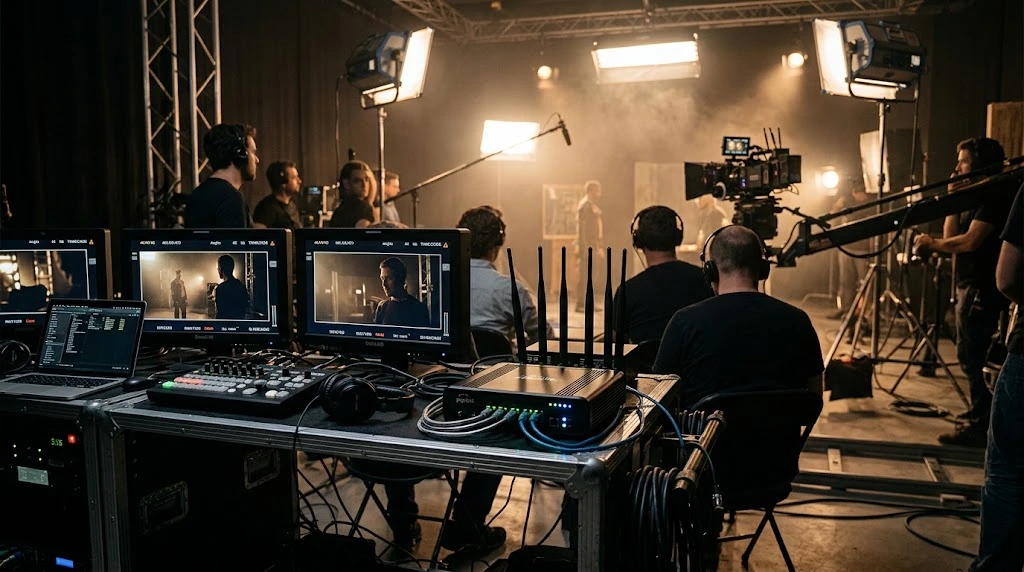
The Camera-to-Cloud (C2C) ingestion pipeline originates directly at the 12G-SDI / 6G-SDI output of cinema camera bodies (ARRI ALEXA 35, RED V-RAPTOR, Sony VENICE). The raw feed links directly to an on-camera hardware encoder such as the Teradek Cube or Serv 4K. The encoder compresses the video signal into lightweight, color-accurate H.264/H.265 proxies using low-latency streaming protocols including SRT (Secure Reliable Transport) or RTMP, while retaining all timecode and audio channel metadata.
An on-set industrial bonding router acts as the aggregation gateway, ingesting encrypted proxy data streams and routing them toward cloud storage architectures (e.g., Frame.io, Sony Ci) for instant editorial access and distributed stakeholder review.
Network layer resiliency hinges on cellular channel aggregation—specifically multi-SIM packet-level bonding. Implemented via hardware-accelerated platforms such as Peplink SpeedFusion SD-WAN, the appliance splits outgoing data packets across multiple independent 4G/5G modems connected to divergent mobile operators (e.g., Orange and SFR simultaneously). SpeedFusion reassembles these packets on a dedicated cloud bonding headend, presenting a singular logical connection to destination cloud services. This architecture delivers sub-second failover and dynamic WAN smoothing: even if a cellular carrier suffers severe cell tower congestion, localized radio interference, or base-station link degradation, zero packets are dropped and continuous media delivery remains fully intact.
Besoin d'une connectivité 4G/5G haute performance sans coupure ?
Chantiers BTP, événements, pop-up stores ou backup entreprise : Welink déploie vos valises 4G/5G multi-opérateurs prêtes à l'emploi partout en France sous 24h.