

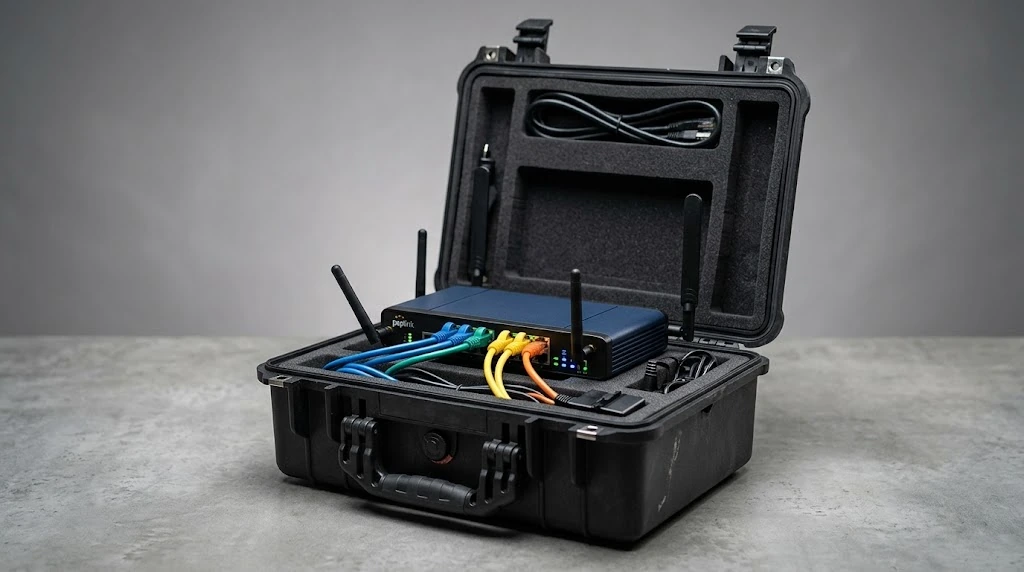
While legacy multi-SIM routers suffer from 15 to 45-second network dropouts during link renegotiation, Peplink SpeedFusion packet-level bonding delivers true 0-second Hot Failover—an operational imperative for mission-critical video streams and aggregated uplinks reaching up to 300 Mbps.
Reading Time: 12 min | Category: SD-WAN Bonding & Peplink Hardware | Updated: September 2026
Key Takeaways
- Peplink Packet-Level Bonding: Peplink SpeedFusion Bandwidth Bonding merges traffic at Layer 2/3 across up to four 5G cellular modems and two Starlink terminals into a single, resilient public IP address. It yields up to 300 Mbps of combined upstream throughput, unlike traditional session-based load balancing that tears down active sockets.
- Zero-Downtime Hot Failover: Standard failover mechanisms drop active TCP/UDP sessions for 15 to 45 seconds during link failure. Peplink Hot Failover maintains active sessions with zero downtime and zero packet loss through Packet Duplication, eliminating drops in POS payment terminals, video conferences, and broadcast feeds.
- Engineered 5G + Starlink Convergence: Pairing Starlink latency (35–65 ms) with low-latency 5G (15–25 ms) via the Dynamic Weighted Bonding algorithm eliminates jitter and stabilizes uplink speeds at up to 300 Mbps. This hybrid topology delivers a faster, more dependable link at roughly one-fifth the cost of a temporary dedicated fiber installation.
- Turnkey, OpEx-Driven Deployment: Welink Tech supplies pre-configured Peplink hardware paired with French-hosted FusionHub core termination points. Turnkey rental packages for multi-SIM Peplink SpeedFusion appliances start at €490/week (excl. VAT), avoiding initial capital expenditures exceeding €4,500.
1. The Myth of Legacy Multi-SIM: Why Session Load Balancing Fails Mission-Critical Workloads
Conventional multi-SIM routers rely exclusively on session-based load balancing. This mechanism distributes inbound TCP/UDP flows sequentially (round-robin) or via weighted metrics across available cellular SIMs. However, every distinct network session remains pinned to a single modem interface. If that specific physical carrier drops, the connection is instantly severed.
Standard failover mechanisms inherently produce service outages. When an active SIM loses connectivity, the appliance must detect link state loss (via health-check pings or carrier loss), renegotiate routing tables, and migrate downstream traffic to an alternate SIM. This renegotiation window introduces 15 to 45 seconds of downtime. For delay-sensitive enterprise workloads, this drop is catastrophic: it terminates live VoIP calls, corrupts POS banking transactions, and resets RTMP/SRT video broadcasts.
Cellular 4G and 5G networks exhibit continuous RF fluctuations. In urban canyons or crowded festival grounds, cells experience transient micro-drops, signal attenuation, and base station congestion. On standard failover routers, these transient drops trigger recurring link-flapping events, causing perpetual session resets and severely degrading user experience.
High-density venues—such as broadcast production trucks, major construction compound field offices, and enterprise exhibitions—require hitless packet delivery. Only true packet-level aggregation, such as Peplink SpeedFusion, overcomes these physical link limitations. SpeedFusion fragments individual IP packets across multiple WAN links simultaneously before reassembling them sequentially at the cloud termination endpoint. If any WAN link fails mid-stream, active sessions remain uninterrupted, ensuring rock-solid resilience for live video streaming and broadcast production and other latency-critical enterprise systems.
[WARNING] The Flaw of Traditional Load Balancing Standard multi-SIM routers (e.g., entry-level Teltonika or stock 4G/5G gateways) balance traffic on a per-session basis. If an active RTMP stream or banking handshake is pinned to SIM 1 and that cellular link drops, the session drops immediately. Only Peplink SpeedFusion packet bonding stripes individual packets across multiple active interfaces without terminating the parent session.
2. Technical Benchmark: Peplink SpeedFusion vs. Standard Multi-SIM Router vs. Dual ISP Lines
This technical benchmark evaluates three prominent enterprise connectivity architectures under operational stress: the Welink Tech Peplink SpeedFusion Turnkey Pack, a standard industrial multi-SIM router (e.g., Teltonika RUTX50), and dual fixed ISP lines (Fiber/VDSL). Each solution is assessed across key engineering vectors governing uptime, capacity, and operational complexity.
Failover duration is the primary differentiator: Peplink SpeedFusion executes a seamless 0-second transition (sub-100ms), whereas standard multi-SIM appliances drop sessions for 15 to 45 seconds. Dual ISP architectures relying on dynamic BGP failover or SD-WAN box re-routing frequently encounter switchover delays of 30 seconds to 5 minutes. With respect to upload aggregation, SpeedFusion delivers a true cumulative pipe reaching 300 Mbps, whereas competitive architectures are restricted to the maximum throughput of a single active interface.
SpeedFusion's WAN Smoothing and Packet Duplication algorithms neutralize jitter, preventing frame drops in critical feeds—a non-negotiable feature for live video streaming and remote broadcast. Maintaining a static public IP address is equally critical: Peplink routes traffic through a fixed, French-hosted core endpoint to maintain continuity for IP-whitelisted enterprise VPNs and business continuity disaster recovery plans (BCP).
Deployment timelines present another stark contrast: Welink provides pre-configured, plug-and-play kits delivered on-site within 24 hours, compared to lead times of up to 3 months for civil works on fixed-line installations. Commercially, Welink's rental model starts at €490/week without long-term commitments, eliminating CAPEX investments exceeding €4,500 for outright enterprise hardware and FusionHub licensing.
[TIP] Mitigating Jitter on Sensitive Real-Time Flows While latency and packet jitter often go unnoticed during web browsing, they degrade real-time video feeds and enterprise VoIP quality by up to 80%. SpeedFusion Packet Duplication and WAN Smoothing eliminate jitter-induced frame drops, ensuring broadcast-grade stability over unpredictable wireless links.
High-Availability Architecture Comparison: Peplink SpeedFusion vs. Standard Multi-SIM vs. Dual ISP Lines
| Technical Metric | Standard Multi-SIM Router (e.g., Teltonika) | Dual ISP Fixed Line (Fiber/VDSL) | Welink Tech Peplink SpeedFusion Pack |
|---|---|---|---|
| Resilience Architecture | Hard session-break failover | ISP BGP routing or basic dual-WAN gateway | SpeedFusion packet-level bonding + Hot Failover |
| Outage Failover Time | 15 to 45-second outage | 30 seconds to 5 minutes | 0 seconds (sub-100ms, completely imperceptible) |
| Usable Upload Capacity | Capped at 1 active SIM (typically 30–50 Mbps) | Bandwidth of the secondary fallback link | Cumulative sum of all WAN interfaces (up to 300 Mbps) |
| Jitter & Packet Loss Mitigation | None (frequent frame freezes and drops) | Moderate (subject to ISP peering routing jitter) | Absolute (Packet Duplication & WAN Smoothing) |
| Public Static IP Persistence | Changes on every cellular failover event | 2 unsynchronized, mismatched public IPs | Persistent, single static French public IP address |
| Lead Time & Cost Structure | Hardware CAPEX €650+ plus data subscriptions | 3-month civil works lead time + 36-month contract | Turnkey 24h delivery from €490/week, zero commitment |
3. SpeedFusion Architecture Unpacked: Bonding, Hot Failover, and Packet Duplication
Peplink SpeedFusion aggregates diverse WAN interfaces into a unified logical pipeline. It bonds up to four distinct 5G cellular modems alongside dual Starlink satellite links, compensating for capacity drops and latency spikes across any single carrier in real time. For a deeper assessment of enterprise cellular aggregation appliances, consult our multi-carrier industrial 4G/5G router benchmark.
Hot Failover continuously monitors connection health across all bonded physical interfaces at the sub-second level. If an interface drops below minimum throughput thresholds or disconnects entirely, SpeedFusion redistributes packet streams over the remaining active links without tearing down active TCP/UDP sockets, providing uncompromising reliability across critical production environments.
Besoin d'une connectivité 4G/5G haute performance sans coupure ?
Chantiers BTP, événements, pop-up stores ou backup entreprise : Welink déploie vos valises 4G/5G multi-opérateurs prêtes à l'emploi partout en France sous 24h.