

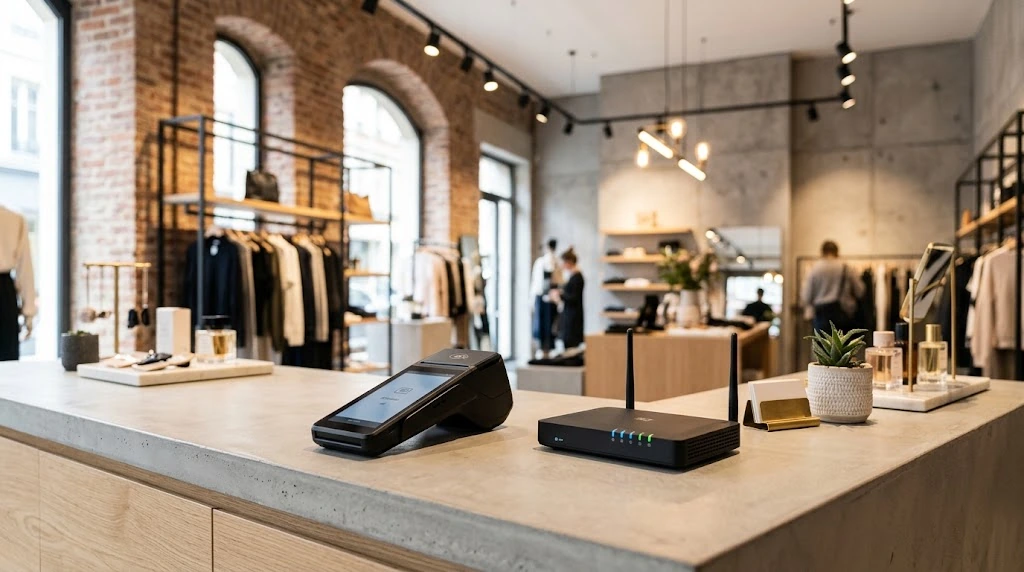
For pop-up stores and temporary retail, a point-of-sale (POS) terminal outage can trigger up to €15,000/day in lost revenue and a 68% immediate cart abandonment rate. Discover how industrial-grade multi-SIM 4G/5G routers guarantee an uninterrupted, PCI-DSS compliant payment infrastructure.
Reading time: 12 min | Category: Retail & Ephemeral Payment Systems | Updated: September 2026
Key Takeaways
- Cost of POS Downtime: Payment interruptions in high-velocity pop-up retail can result in up to €15,000 in lost revenue per day, with 68% of consumers abandoning their purchase immediately upon transaction failure.
- Vulnerabilities of Consumer 4G Dongles: Consumer-grade hotspots lack hardware VLAN segmentation, mixing encrypted financial transactions with guest Wi-Fi. This violates PCI-DSS requirements, collapses under loads as small as 5 concurrent devices, and triggers authorization timeouts.
- Multi-Carrier Carrier-Grade Redundancy: Enterprise Welink routers aggregate multiple tier-1 cellular backhauls (Orange, SFR, Bouygues Telecom, Free Mobile) with sub-300ms automated failover, maintaining active SSL/TLS payment sessions without transaction drops.
- Rapid Turnkey Provisioning: Hardware ships fully pre-configured within 24 hours nationwide across France, enabling operational readiness in under 3 minutes with zero on-site technician requirements and zero-commitment lease terms.
1. The Cost of POS Silence: Why Ad-Hoc Connectivity Paralyzes Pop-Up Retail
Temporary retail environments demand immediate, mission-critical network availability. Deploying makeshift solutions—such as consumer smartphone tethering or single-carrier USB dongles—introduces severe operational vulnerabilities, security non-compliance, and direct financial hemorrhaging. What is planned as a high-margin brand showcase can quickly devolve into a liabilities nightmare.
Financial losses from payment terminal downtime are instant and unrecoverable. Empirical retail studies establish a 68% consumer abandonment rate in ephemeral retail formats upon the very first card processing failure. For high-footfall pop-up locations, this translates into daily revenue losses reaching up to €15,000. In short-lived retail activations, missed transactions cannot be recouped later.
Smartphone personal hotspots introduce hardware-level vulnerabilities:
- Thermal Throttling & Battery Swelling: Mobile hardware running sustained tethering under heavy concurrent loads experiences extreme thermal degradation, forcing cellular modems to throttle backhaul throughput or crash.
- Layer-4 Session Drops: Inbound voice calls or cellular band re-allocations instantly sever active SSL/TLS handshake tunnels on connected POS terminals, immediately voiding authorizations mid-swipe.
Single-carrier consumer 4G dongles are structurally unsuited for high-density retail. Their upstream capacity collapses as soon as 5 to 8 devices associate to the radio, an inevitable scenario in dense urban centers or exhibition venues where radio frequency (RF) spectrum is congested. This bottleneck stalls POS packet transmission, introduces fatal latency spikes, and terminates transactions at the gateway level.
Furthermore, PCI-DSS (Payment Card Industry Data Security Standard) compliance requires strict, verifiable data isolation. Intermingling unencrypted guest/staff smartphone traffic with cardholder data environments (CDE) on a non-segmented consumer hotspot constitutes a direct compliance violation. This exposes retailers to severe forensic audit penalties, merchant account revocations, and catastrophic reputational damage.
[WARNING] The True Cost of Smartphone Tethering Relying on a mobile phone hotspot to process credit card transactions exposes the merchant to immediate revenue loss. A single incoming call or cell tower handover cuts the uplink to the POS terminal, dropping the TLS encryption tunnel mid-transaction. Direct impact: 100% of that sale is forfeited on the spot.
2. Temporary Retail Connectivity Benchmark: TCO, Latency, and Resiliency
Deploying an ephemeral retail store requires instantaneous, resilient network connectivity. A comparative benchmark of available deployment topologies highlights critical operational trade-offs across deployment lead times, continuous uptime, and Total Cost of Ownership (TCO).
Deployment agility is the baseline requirement. While smartphone tethering is instantaneous, its unreliability disqualifies it for commercial enterprise use. Conversely, legacy telecom carriers (e.g., Orange Business, SFR Business) impose provisioning lead times of 4 to 8 weeks for temporary fiber or copper drops—an operational timeline fundamentally misaligned with pop-up leases running for days or weeks. In contrast, pre-configured enterprise 4G/5G cellular routers ship within 24 hours and achieve full operational readiness under 3 minutes post-power-on.
Transaction continuity and traffic isolation remain non-negotiable. Consumer dongles lack carrier redundancy, leaving points of sale vulnerable to single-point-of-failure (SPOF) outages during local mast congestion. Only enterprise-grade multi-SIM industrial hardware equipped with sub-300ms automated failover and native 802.1Q banking VLAN segmentation can isolate payment infrastructure while ensuring continuous transaction processing.
Financial calculations expose significant hidden costs in carrier contracts. Traditional B2B fixed-line contracts mandate 12 to 36-month commitments, burdening short-term activations (lasting 3 days to 2 months) with exorbitant termination penalties. A zero-commitment hardware leasing framework—billed strictly per day, week, or month—optimizes TCO by aligning operational expenditures directly with the retail calendar.
Mitigating the risk of downtime demonstrates the immediate ROI of enterprise connectivity. A pop-up generating €4,000 per day loses €1,000 during a 2-hour peak-traffic outage. Across a 30-day lease, two such incidents represent €2,000 in unrecoverable losses. Investing in carrier-grade routing with 99.99% operational availability acts as an insurance policy protecting top-line revenue.
[WARNING] Quantifying Outage Costs: Direct Revenue Loss Flaky internet during peak hours causes immediate, unrecoverable revenue loss. For a boutique processing €500/hour in gross sales, a 3-hour network blackout costs €1,500—surpassing the total rental cost of an enterprise-grade cellular router for an entire month. Prevention always costs less than outage remediation.
Connectivity Architecture Comparison for Pop-Up Retail
| Evaluation Metric | Smartphone 4G Tethering | Single-Carrier Consumer 4G Dongle | Welink Multi-SIM Enterprise 4G/5G Router |
|---|---|---|---|
| Lead Time to Deploy | Immediate | 24h to 48h (Retail Store Pickup) | Pre-configured, delivered in 24h |
| POS Transaction Reliability | Critical Failure Risk (Drops on call/standby) | Poor (Local cell saturation, no backup) | Maximum (Sub-300ms multi-SIM failover) |
| Payment Traffic Isolation | Impossible (Flat, unmanaged subnet) | Non-existent | Hardware 802.1Q VLAN & QoS prioritization |
| Max Concurrent Devices | 3 to 5 clients max | 5 to 8 clients max | 50 to 250 enterprise clients |
| Contractual Terms | Tied to mobile plan | 12 to 24-month lock-in | Zero commitment (Billed per day/week/month) |
| Telemetry & NOC Support | None | Consumer tier-1 call center | Dedicated 24/7 Enterprise NOC monitoring |
3. Air-Gapped Network Architecture: VLAN Segmentation and Sub-300ms Failover
Welink industrial routers enforce enterprise-grade network compartmentalization directly out of the box. Utilizing hardware-enforced IEEE 802.1Q VLAN segmentation, the router provisions isolated layer-2 environments from a single physical chassis. This topology guarantees complete PCI-DSS compliance:
- VLAN 10 (Restricted Payment Network): Dedicated exclusively to POS terminals, EFTPOS systems, and cash registers. This subnet enforces zero-trust stateful firewalling, packet-level Quality of Service (QoS) prioritization for payment payloads, and strict denial of inter-VLAN routing.
- VLAN 20 (Operations & Back-Office): Allocates bandwidth for inventory management, ERP synchronization, and staff tablets.
- VLAN 30 (Guest & Marketing Wi-Fi): Completely sandboxed, rate-limited public network with client isolation, ensuring public traffic cannot intercept, sniff, or congest payment telemetry.
High-availability continuity is driven by hardware-assisted multi-WAN health monitoring. Dual or quad-SIM cellular modems maintain continuous health checks (via Layer-3 ICMP echo probing and DNS query tracking) across all four French tier-1 cellular networks (Orange, SFR, Bouygues Telecom, Free Mobile).
When RF degradation, base transceiver station (BTS) congestion, or core routing failures occur on the primary cellular link, the router triggers a sub-300ms stateful failover. By leveraging active connection tracking and protocol-level session preservation (SpeedFusion / Hot Failover mechanisms), the cellular link switches before TCP/TLS sockets can reset. The POS terminal completes its payment capture uninterrupted, eliminating failed transactions, merchant frustration, and revenue loss.
Besoin d'une connectivité 4G/5G haute performance sans coupure ?
Chantiers BTP, événements, pop-up stores ou backup entreprise : Welink déploie vos valises 4G/5G multi-opérateurs prêtes à l'emploi partout en France sous 24h.