

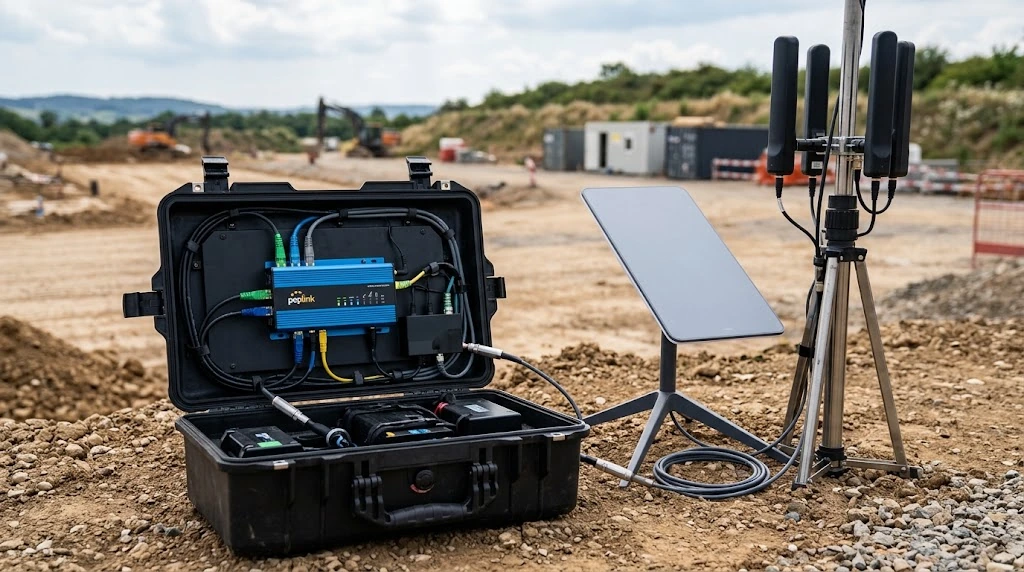
Starlink micro-outages lasting 200–800 ms routinely drop POS transactions, disrupt VoIP calls, and tear down VPN tunnels. Peplink SpeedFusion SD-WAN bonding delivers true 0 ms hitless failover and aggregated throughput reaching up to 400 Mbps.
Reading Time: 12 min | Category: SD-WAN Bonding & 5G Hybridization | Updated: September 2026
Key Technical Takeaways
- Starlink Micro-Outages: LEO satellite handovers and transient line-of-sight blockages generate recurring 200–800 ms interruptions that instantly kill POS payment terminals, cashless RFID ticketing, and IPsec VPN tunnels.
- SpeedFusion Bonding: Intelligent packet-level duplication across Starlink and two distinct 5G cellular modems guarantees 0 ms hitless failover, flattened jitter, and combined throughput up to 400 Mbps.
- Router Selection: The Teltonika RUTX50 provides responsive sub-second failover (<300 ms) for cost-conscious site trailers, while the Peplink MAX BR1 Pro 5G delivers packet-level SpeedFusion bonding (0 ms dropouts) for mission-critical live event productions.
- Welink Tech Rapid Deployment: Turnkey, preconfigured ruggedized PeliCase kits deployed within 24 hours across France, fully operational in 10 minutes without on-site telecom technicians, backed by 24/7 NOC engineering support.
1. Anatomy of a Starlink Micro-Outage: Why Standalone Satellite Fails on Job Sites
The Starlink constellation relies on Low Earth Orbit (LEO) satellite infrastructure. Orbiting at approximately 27,000 km/h, each satellite passes out of view rapidly, forcing ground terminals to perform beam steering and satellite handovers every 4 to 8 minutes to sustain the downlink. While imperceptible for consumer web browsing, this high orbital velocity introduces structural vulnerabilities in high-demand enterprise deployments.
These handovers introduce inherent micro-disconnects, even under clear-sky conditions. As the ground transceiver retunes from a setting satellite to an ascending one, the momentary RF realignment causes phase jitter and burst packet loss, resulting in 200 to 800 ms of packet loss. While video streaming buffers easily absorb this dip, sensitive enterprise traffic cannot: point-of-sale (POS) card swipes abort, cashless RFID ticketing gates freeze, and persistent SSH or IPsec/SSL VPN tunnels collapse immediately, halting field operations.
On active construction sites, physical topology compounds this vulnerability. Unpredictable line-of-sight obstructions frequently break the transceiver's required field of view. Rotating tower cranes, shifting scaffolding platforms, temporary site hoists, and deep quarry walls routinely occlude the satellite's direct sky path. These physical interruptions—even lasting only a few seconds—break the carrier lock and cause uncontrollable outages. Mitigating these physical constraints requires active multi-WAN hybrid resilience.
[WARNING] The Physical Reality of LEO Satellite Handovers A satellite link is not a continuous terrestrial cable. When the terminal switches from an outgoing satellite near the horizon to an incoming satellite overhead, radio tracking and phase lock latency introduce acute jitter and micro-packet loss. While invisible to buffered media streams, this drop is instantly fatal to electronic payment terminals, database locks, and live industrial telemetry.
2. Resilience Architecture Benchmark: Passive WAN Failover vs. Active SpeedFusion Bonding
Temporary field connectivity mandates carrier-grade operational resilience. Isolated deployments—such as relying on a standalone Starlink terminal or a standard dual-WAN router with basic passive failover—introduce single points of failure that disrupt business-critical workflows.
Standard WAN failover algorithms operate on ping-based health checks. When the primary link degrades, the router requires 15 to 30 seconds to detect the dead gateway, update its routing table, and transition traffic to the secondary interface. This delay inevitably terminates all stateful IP sessions. Active VoIP calls disconnect, real-time POS authorizations time out, and remote desktop sessions drop, forcing manual reconnection and causing substantial user downtime. Passive failover is fundamentally inadequate for zero-downtime environments.
Peplink SD-WAN architecture, powered by proprietary SpeedFusion technology, replaces this reactive model. Through SpeedFusion WAN Smoothing, the router duplicates individual packets simultaneously across every available uplink: typically, one Starlink dish and two discrete Tier-1 5G/LTE modems. This creates true active-active redundancy with 0 millisecond failover. If a satellite handover or line-of-sight obstruction drops packets on the Starlink interface, identical packets traversing the 5G paths ensure zero packet loss and unbroken session persistence.
In addition to hitless resilience, Peplink Bandwidth Bonding aggregates disparate links into a single logical pipe at the packet level. Combining an enterprise Starlink link delivering 250 Mbps down with two diverse 5G cellular paths delivering an additional 150 Mbps produces a reliable, aggregated capacity of up to 400 Mbps. This architecture delivers high-throughput, symmetrical performance capable of handling large BIM CAD synchronization and high-definition multi-camera live video streaming simultaneously.
[WARNING] Quantifying Downtime Costs A 15-second connectivity drop at a high-volume point-of-sale location generating €1,000/hour incurs a direct transaction loss of €4.17. Across a distributed network or festival with 100 payment terminals, a single concurrent micro-outage causes €417 in immediate lost revenue. At an average frequency of 5 events per month, annual baseline losses exceed €25,000.
Hybridization Architecture Comparison: Standalone Starlink vs. Basic WAN Failover vs. Welink Tech SpeedFusion Bonding
| Reliability Metric | Standalone Starlink | Starlink + Basic 4G Router (Passive Failover) | Starlink + Hybrid 5G SD-WAN (Peplink SpeedFusion) |
|---|---|---|---|
| Session Continuity (VoIP/POS) | 200–800 ms drops on every handover | 15 to 30 s complete outage during WAN switch | 0 ms hitless failover (packet duplication via SpeedFusion) |
| Resistance to Cranes & Obstructions | Total signal failure during occlusion | Delayed switchover after session collapse | Immediate, seamless mitigation via parallel 5G carriers |
| Usable Downstream Bandwidth | Satellite capacity only (100–250 Mbps) | Active link only (no aggregation) | Fully bonded bandwidth (Starlink + 2x 5G = up to 400 Mbps) |
| Latency Profile & Jitter | Variable (25–80 ms, sharp jitter spikes) | High instability during interface toggle | Stabilized and flattened latency (WAN Smoothing engine) |
| Lead Time & Deployment | 2–3 weeks direct delivery | Manual multi-vendor assembly and config | Plug-and-play ruggedized PeliCase kit deployed in 24h |
| Mission-Critical Support | Web ticketing only, no dedicated SLA | Consumer carrier call centers | 24/7 direct access to tier-3 NOC network engineers |
3. Network Architecture Engineering: Teltonika RUTX50 vs. Peplink MAX BR1 Pro 5G
Designing field network infrastructure requires balancing throughput, operational complexity, and hardware cost. Two specific hardware platforms address distinct deployment profiles:
For base-camp site trailers, security turnstiles, and temporary retail kiosks, the Teltonika RUTX50 delivers an industrial, cost-efficient platform. Encased in a ruggedized aluminum chassis rated for harsh operating temperatures, it provides rapid automated failover in under 300 ms. Featuring dual-SIM failover capabilities, it switches between primary and backup cellular networks automatically if primary telemetry fails, serving as a dependable basic gateway for non-bonded environments.
For high-density live event broadcasts, cashless festival backbones, and mission-critical construction headquarters, the Peplink MAX BR1 Pro 5G represents the industry benchmark. Its integrated SpeedFusion Bonding engine combines heterogeneous Starlink and 5G connections into a single resilient tunnel, while WAN Smoothing dynamically mitigates packet loss. Combined with granular Layer 7 Application QoS, it prioritizes critical traffic (POS systems, voice, and production video) over background corporate browsing, guaranteeing flawless transmission quality even under severe network congestion.
Besoin d'une connectivité 4G/5G haute performance sans coupure ?
Chantiers BTP, événements, pop-up stores ou backup entreprise : Welink déploie vos valises 4G/5G multi-opérateurs prêtes à l'emploi partout en France sous 24h.